

Vanuatu is a country of more than 80 islands spread across the South Pacific Ocean. From a telecommunications perspective, this creates one of the most challenging environments for building and maintaining a reliable mobile network. Every island needs dependable backhaul connectivity, stable power, resilient infrastructure and continuous maintenance. Unlike countries with large connected land areas, every expansion project in Vanuatu involves additional engineering, logistics and cost. So, now let us see Why Is Vanuatu Investing So Much in Digital Infrastructure Before Large-Scale 5G Deployment along with Smart LTE RF drive test tools in telecom & Cellular RF drive test equipment and Smart Wireless Survey Software Tools & Wifi site survey software tools in detail.
Instead of focusing only on launching more mobile sites, Vanuatu has chosen to strengthen the foundation of its communications network first. This includes submarine fibre infrastructure, government broadband networks, cloud infrastructure and disaster-resilient communications. This approach may appear slower than rapid 5G rollouts seen in larger countries, but technically it creates a much stronger platform for future mobile network expansion.
One of the biggest developments is the Tamtam Submarine Cable Project, which will connect Port Vila in Vanuatu with Lifou in New Caledonia while also extending domestic fibre connectivity to islands including Espiritu Santo, Malekula and Tanna. The project provides an additional international route instead of relying on a single submarine cable. This improves redundancy, increases available bandwidth and reduces the risk of nationwide communication outages if one cable is damaged.
For mobile operators, additional fibre capacity directly improves network performance. Modern 4G and future 5G networks generate significantly more traffic than previous generations. Radio access networks can only perform well when supported by sufficient transport capacity between base stations and the core network. Increasing radio capacity without strengthening fibre backhaul simply shifts congestion from the air interface to the transport network.
Another interesting feature of the Tamtam project is that it goes beyond telecommunications. The submarine cable includes SMART sensing technology that can monitor seismic activity, detect tsunami events and collect oceanographic information. This means one infrastructure investment supports broadband connectivity while also strengthening disaster monitoring and public safety. For a country regularly affected by earthquakes, volcanic activity and tropical cyclones, combining communications and environmental monitoring provides long-term operational benefits.
Vanuatu’s digital strategy also focuses on improving government communications. Current programmes include expanding the Government Broadband Network, developing national data centre capabilities and increasing cloud adoption across public services. These investments improve communication between government departments while creating a secure digital platform that can support additional online services in the future.
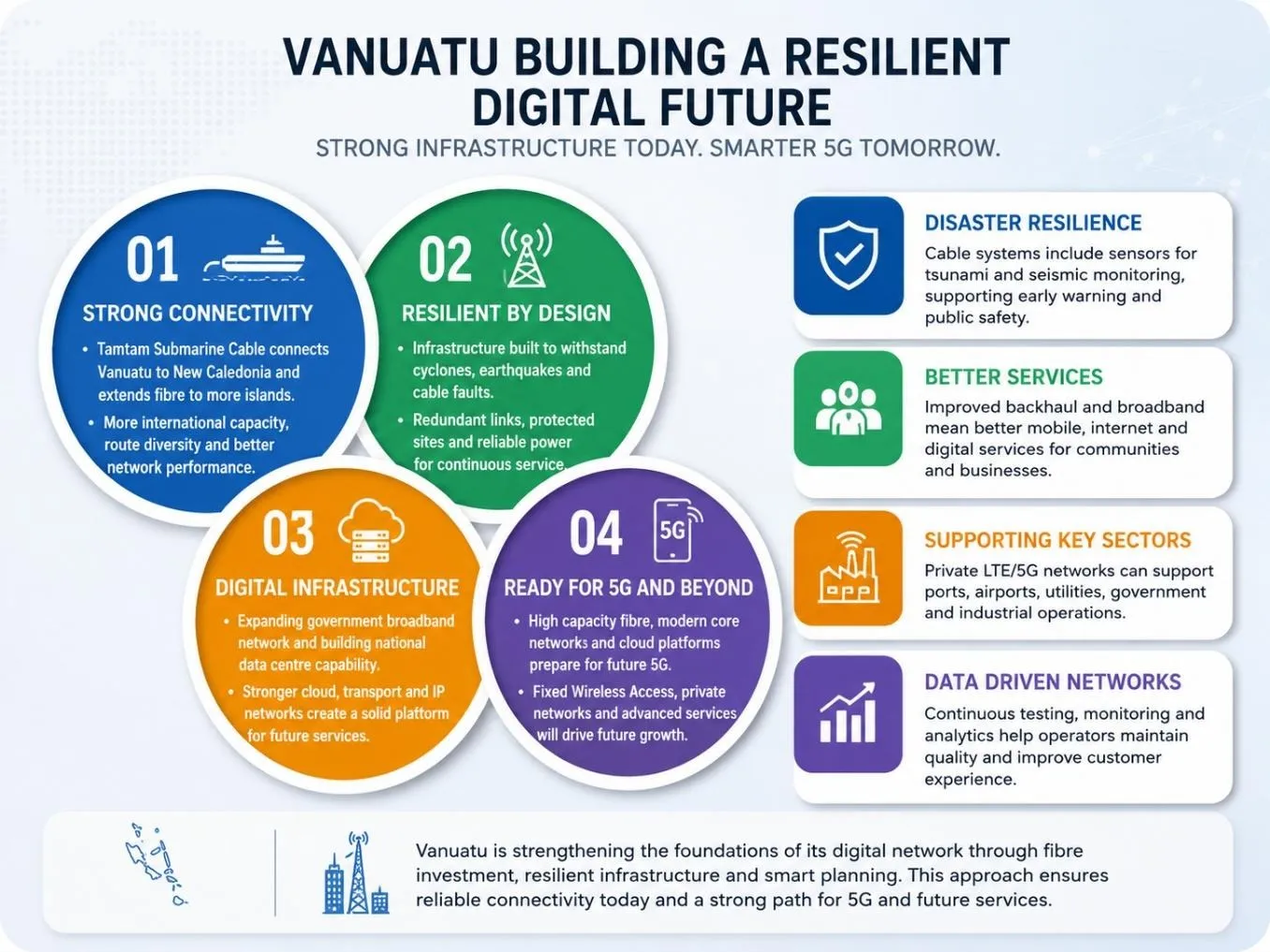
Resilience has become one of the most important design requirements for telecommunications infrastructure in Pacific island countries. Cyclones, earthquakes, volcanic eruptions and underwater cable faults can all interrupt communications. Every network outage affects emergency response, banking, education, healthcare and government services. Because of this, network planners are giving greater attention to redundancy, route diversity and infrastructure protection instead of simply increasing network coverage. This follows a broader international focus on strengthening submarine cable resilience, particularly for small island developing states that depend on only a few international cable systems.
These improvements also prepare the country for future 5G deployment. Although nationwide 5G expansion is not yet the immediate priority, much of the required infrastructure is already being established. Higher-capacity fibre, improved broadband transport, stronger core infrastructure and better disaster resilience all create favourable conditions for introducing advanced mobile services when demand continues to grow.
As mobile traffic continues to increase, operators will eventually need to introduce technologies that deliver higher capacity, lower latency and improved network efficiency. The work already underway in Vanuatu makes this transition much easier. A strong fibre network, modern IP transport and reliable international connectivity provide the building blocks required for advanced 5G services. Without these elements, even the latest radio technology cannot deliver consistent performance.
One area expected to benefit significantly is fixed wireless broadband. Many islands have communities where extending fibre directly to every home is expensive and time-consuming. In these locations, 5G Fixed Wireless Access (FWA) can provide high-speed broadband using existing mobile infrastructure. This allows operators to deliver faster internet services without installing new fibre to every customer premises. As fibre backhaul expands across more islands, FWA becomes an increasingly practical solution for improving broadband coverage.
Another technology likely to play an important role is private wireless networking. Ports, airports, utility companies, government facilities and industrial sites require secure, reliable communications for day-to-day operations. As these sectors continue to modernise, private LTE and private 5G networks can support operational applications such as asset monitoring, connected sensors, workforce communications and video surveillance. While large-scale deployments may still be some years away, the supporting network infrastructure is gradually moving in the right direction.
Cloud-native network architecture is another area receiving increasing attention across Pacific island nations. Moving network functions into virtualised environments gives operators greater flexibility when expanding services, introducing new applications or recovering from unexpected failures. Instead of depending entirely on dedicated hardware, operators can scale network resources more efficiently while improving operational resilience. This approach also simplifies software upgrades and helps reduce service interruptions during maintenance.
For network engineers, maintaining service quality across multiple islands presents unique operational challenges. Every radio site, microwave link, fibre segment and core network element must work together without creating performance bottlenecks. Monitoring user experience therefore becomes just as important as monitoring network availability.
As future 5G services become available, continuous network testing will become even more important. Engineers will need accurate visibility of radio performance across highways, towns, ports, airports, tourist locations and remote communities. Automated drive testing, indoor walk testing, cloud-based analytics and real-time reporting allow engineering teams to monitor network quality without relying entirely on manual field measurements. These tools also support faster troubleshooting, network optimisation and performance benchmarking as new sites are commissioned.
Disaster recovery will continue to influence every stage of network planning in Vanuatu. Mobile infrastructure must remain operational during cyclones, earthquakes and volcanic events, while restoration activities need to be completed as quickly as possible after any disruption. Redundant fibre routes, resilient core infrastructure, protected power systems and continuous network monitoring all contribute to maintaining communication services when they are needed most.
Vanuatu’s current investment strategy shows that successful mobile networks depend on much more than additional base stations. Fibre connectivity, resilient transport networks, cloud infrastructure, government broadband programmes and reliable international links all work together to create a stable communications platform. This technical foundation gives operators the flexibility to introduce advanced mobile services while maintaining consistent network performance across widely dispersed islands.
For the telecommunications industry, Vanuatu provides an excellent example of long-term network planning. Rather than rushing into nationwide 5G deployment, the country is strengthening the infrastructure that will support future growth for many years. As broadband demand continues to increase and more digital services become available, this approach is likely to deliver stronger network reliability, improved customer experience and a more resilient communications environment across the Pacific region.
About RantCell
RantCell is a cloud-based mobile network testing and monitoring solution used by mobile network operators, system integrators, regulators, enterprises and private network providers worldwide. It supports automated drive testing, indoor walk testing, fixed wireless testing and continuous network monitoring using Android smartphones and CPE devices. The platform provides real-time cloud analytics, automated reporting and APIs for integration with OSS and third-party systems, helping engineering teams improve network performance while reducing testing costs. Also read similar articles from here.
