

Your store had a record month. Revenue is up, the ad spend paid off, and the warehouse is busy. Then your accountant asks two questions. How much sales tax did you collect by state? What is your inventory worth today?
Many online sellers cannot answer either one with confidence. Those two numbers drive your tax bill, your margins, and your ability to borrow. This guide explains how good ecommerce bookkeeping services keep both clean, and what to check before you hire anyone.
Why Ecommerce Books Go Wrong First
Ecommerce looks simple from the outside. Orders come in, money lands in the bank, and products ship out. Underneath, each sale touches five or six systems at once.
A single order can involve your storefront, a payment processor, a marketplace, a shipping tool, and your accounting file. Each one records the sale differently. The storefront shows the gross order. The processor deposits a smaller amount after fees. The marketplace may collect tax on your behalf, or it may not.
A generic bookkeeper often posts the bank deposit as income and moves on. That one shortcut hides fees, understates sales, and breaks the link to sales tax and inventory. The books look tidy, but they are wrong.
The Two Problems That Cost Sellers the Most
Sales tax and inventory are where ecommerce errors turn into real money. Both also grow quietly as you sell in more places.
Sales Tax: Collecting Is Not the Same as Remitting
Since the 2018 South Dakota v. Wayfair ruling, states can require out-of-state sellers to collect sales tax once they pass a sales threshold. Many states use $100,000 in annual sales as a trigger, though rules differ by state. You can owe tax in places where you have no office, no staff, and no warehouse.
Marketplace rules add another layer. In most states, marketplaces like Amazon and Etsy collect and remit tax on orders placed through their platforms. Sales on your own website are still your responsibility. Many sellers mix the two and either overpay or underpay.
Here is a simple picture of how a gap forms:
- Your store collected $4,200 in sales tax this quarter.
- You remitted $3,900 across your filings.
- The $300 difference sits in a liability account, unexplained.
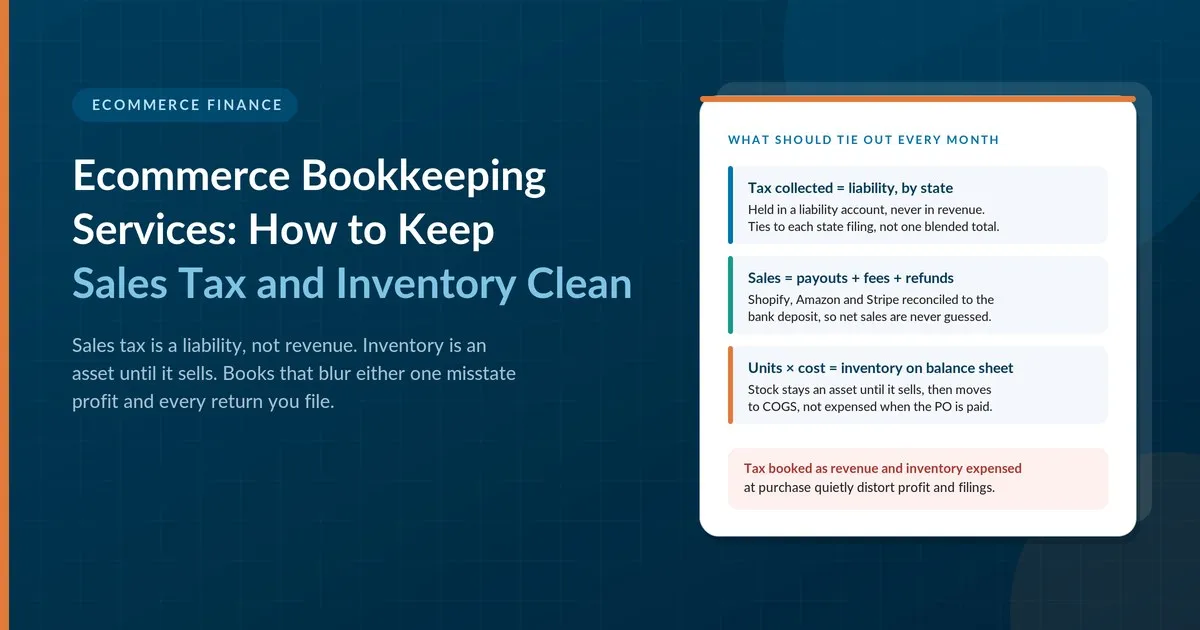
Small gaps like this compound. After a few quarters, no one can say whether the balance is a real debt or a bookkeeping error. A good bookkeeper reconciles collected tax to filed tax every month, by state.
Product type matters too. Some items are taxable in one state and exempt in another. Clothing, food, and digital goods are common examples. This guide to product taxability by state shows why one tax setting across your whole catalog can create errors.
Inventory: The Number That Moves Your Profit
Inventory is cash sitting on a shelf. It also decides your cost of goods sold, which decides your profit.
The formula is straightforward. Beginning inventory plus purchases minus ending inventory equals cost of goods sold. Take a seller with $80,000 of opening stock who buys $120,000 more during the year and ends with $70,000. Cost of goods sold is $80,000 + $120,000 − $70,000 = $130,000.
Now suppose the ending count is wrong by $15,000 because returns and damaged goods were never recorded. Your cost of goods sold is off by the same amount, and so is your taxable profit. The IRS expects inventory to be valued with a consistent method. Its Publication 538 on accounting periods and methods explains the basics.
Many sellers record inventory only at year-end. By then, no one remembers which purchases belonged to which products. Monthly tracking prevents that.
What Good Ecommerce Bookkeeping Services Should Include
Compare offers by what they deliver each month, not by the headline price. A solid package covers these items:
- Channel-level revenue. Sales are recorded gross, by channel, with fees and refunds shown separately.
- Payout reconciliation. Every deposit from Shopify, Amazon, or Stripe matches the orders behind it.
- Sales tax tracking by state. Collected tax is separated from revenue and compared to what you filed.
- Inventory and COGS tracking. Purchases, landed costs, and ending stock are updated monthly.
- Clean reports. You get a profit and loss, balance sheet, and gross margin by channel on a set date.
If a provider only promises to “categorize your transactions,” that is data entry. Price it accordingly. Firms that offer true ecommerce accounting services should be able to show a sample monthly package with customer names removed.
A Realistic Monthly Rhythm
Ask any candidate to describe a typical month. A workable rhythm looks like this:
| Timing | Task |
|---|---|
| Week 1 | Pull payout reports from each channel and match them to bank deposits |
| Week 2 | Reconcile card accounts, post fees and refunds, review sales tax collected |
| Week 3 | Update inventory records and landed costs, flag slow or damaged stock |
| Week 4 | Close the month, review margins by channel, send reports |
Where Online Sellers Commonly Slip
Most of the problems we see come from the same handful of habits:
- Booking deposits as revenue. Fees disappear, and margins look better than they are.
- Ignoring refunds and chargebacks. Returns pile up as unexplained bank activity.
- Treating shipping costs as one bucket. You cannot see whether free shipping is eroding profit.
- Skipping nexus reviews. Sales cross a state threshold, and no one notices for a year.
- Counting inventory once a year. Errors from twelve months of activity land in one tax return.
Questions to Ask Before You Hire
Use these on your first call. Specific answers signal real ecommerce experience.
- How many ecommerce clients do you serve, and on which platforms?
- How do you reconcile Shopify or Amazon payouts to bank deposits?
- How do you separate marketplace-collected tax from tax we owe?
- Who tracks sales tax thresholds by state, and how often?
- How do you value inventory, and when is it updated?
- What date do I receive monthly reports?
In-House, Freelancer, or Outsourced Team?
An in-house bookkeeper gives you daily access, but one person rarely covers platform reconciliation, sales tax, and inventory equally well.
A freelancer can work for a single-channel store with simple products. The risk is coverage. If that person is unavailable during a busy season, your books stall.
An outsourced team brings platform experience, set routines, and backup coverage. For sellers on two or more channels, or those selling across many states, this usually offers the best balance of cost and depth.
The right test is simple. Who will keep your sales tax and inventory accurate in month twelve, not just month one?
A Practical Way to Start
If your books feel behind, move in this order:
- Reconcile the last three months of payouts to bank deposits.
- Compare sales tax collected to sales tax filed, by state.
- Count inventory and compare it to your records.
- Review where your sales volume sits against state thresholds.
- Set a monthly close date and hold your provider to it.
Final Thought
Ecommerce growth hides bookkeeping problems until they get expensive. Sales tax gaps and inventory errors rarely show up in a single month. They build over quarters and surface at tax time or during a funding review. Choose a provider who talks about payouts, states, and stock counts before they talk about software. That choice protects your margins and your filings as you scale.
This article is for general information only and is not tax or legal advice. Consult a qualified professional about your situation.
About the author: Vandana Mehta, CA, CPA (USA), is a compliance and financial reporting specialist at Datastub, an outsourced accounting and bookkeeping firm serving U.S. ecommerce sellers, contractors, and growing small businesses. Crunch. Strategize. Deliver.
