

Senior hiring has always depended on judgment, discretion, and relationships. That is why executive recruitment can seem like an unlikely place for automation. Yet the slowest parts of a search are not always the parts that require senior judgment. Used carefully, recruiting automation software built for full cycle recruiting can remove administrative work while leaving the conversations that matter with partners, founders, boards, and hiring leaders.
The distinction is important. An executive search should not feel like a mass-market funnel. Candidates at this level expect context, confidentiality, and a credible reason for being approached. The goal of technology is not to automate the relationship. It is to stop experienced recruiters from spending unnecessary time on repeatable tasks around that relationship.
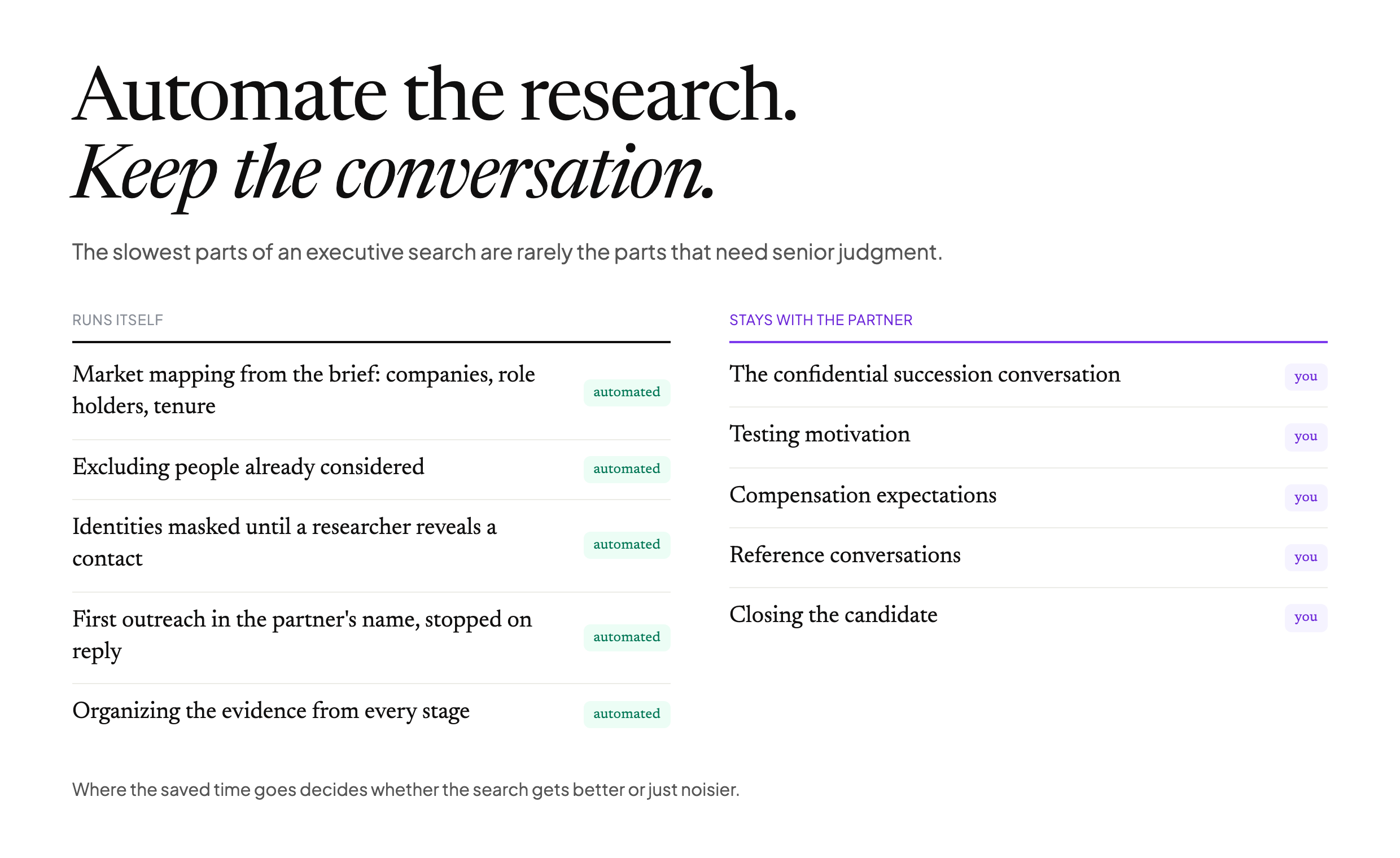
Automate the research, keep the conversation: market mapping, list cleaning and evidence organization run themselves; motivation, compensation, references and the close stay with the partner.
Research Is Valuable, but It Can Become a Bottleneck
An executive search often begins with market mapping. Researchers identify relevant companies, adjacent sectors, likely titles, career patterns, and people who may not be actively looking. This work is essential because the strongest candidate may never submit an application.
However, researchers can spend hours moving between databases, checking similar profiles, cleaning lists, and revisiting people already considered. Search technology can help surface a broader pool and organize it more efficiently. The recruiter still needs to judge whether a person’s scale, remit, reputation, and career direction make sense for the assignment.
This is where executive search technology has moved furthest. A mandate written as a one-line brief can be parsed into filters on the person and on their company, including current and previous employer, industry and headquarters, so that the first draft of a talent map, with role holders, tenure and likely-to-move signals, comes from the brief rather than from weeks of collection. Everyone already considered is excluded from the next search automatically. Identities stay masked in results until a researcher chooses to reveal a contact, which is the same discretion an executive search firm has always promised, applied one step earlier.
Senior Candidates Need a Better Reason to Engage
Automation is less helpful when it produces generic outreach. An executive who is performing well in a current role is unlikely to respond to a message that reads like a copied job advertisement. The first contact needs to explain why the opportunity is relevant to that individual.
That usually means understanding the challenge behind the role. Is the company entering a new market? Rebuilding a leadership team? Preparing for a change in ownership? Scaling from one stage of growth to another? The more senior the candidate, the more important this context becomes. Where recruitment automation helps here is narrow and useful: the message drafted from the brief and the person’s actual record, sent in the partner’s name, and stopped the instant the person replies so that nobody senior ever receives step 2 of a sequence.
Use Structure Before the Interview Begins
Executive interviews can become inconsistent because senior candidates are skilled communicators and every conversation takes a different direction. That does not mean the process should be scripted. It means the search team should agree in advance on the capabilities and evidence that matter.
For example, a board recruiting a chief operating officer may want to understand how candidates have handled restructuring, cross-functional conflict, operating discipline, and rapid growth. The questions can differ, but the underlying evidence should remain comparable. A structured framework helps prevent charisma or a familiar career story from dominating the discussion.
Technology Should Strengthen the Evidence Pack
Good executive search software can support the work around candidate research, interview records, shortlisting, and collaboration. It becomes more valuable when information from different stages is connected instead of living across private notes, email threads, and spreadsheets.
A partner preparing for a client update should be able to see why a candidate entered the search, what concerns appeared during evaluation, and which examples support the team’s view. Technology can organize that evidence, but the partner remains responsible for interpreting it and explaining the trade-offs to the client. A live first-round conversation scored against the agreed framework, with the transcript behind each score, gives the partner a consistent first read on every candidate before the personal interviews begin.
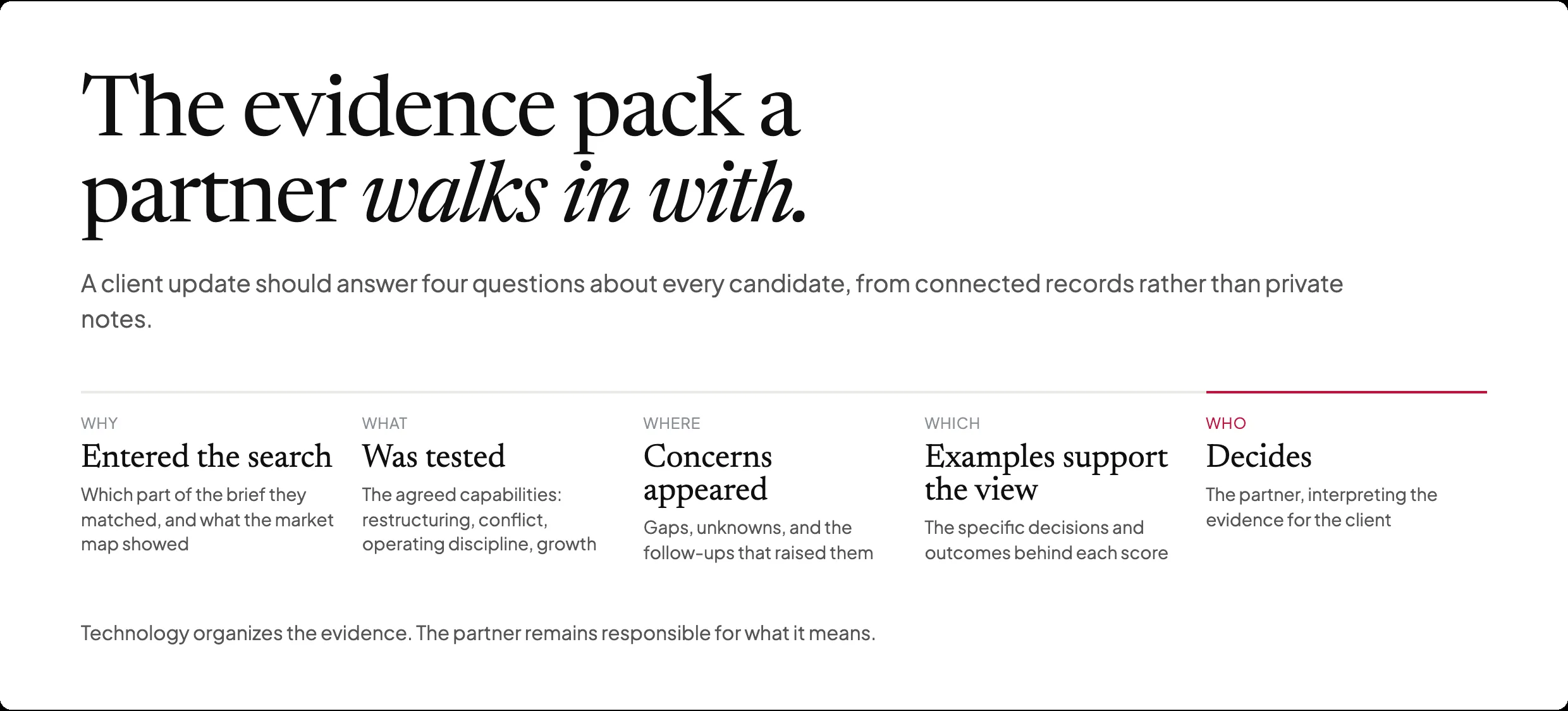
The evidence pack a partner walks into the client update with: why each candidate entered the search, what was tested, what concerned the team, and which examples support the view.
Know Which Steps Should Stay Human
Some activities are suitable for automation because they are repetitive and rules-based. Scheduling across time zones, reminders, initial research organization, and consistent documentation are obvious examples. Parts of sourcing and first-stage evaluation may also be supported by software when there is a clear rubric and human review.
Other activities should remain deliberately personal. Discussing a confidential succession issue, testing motivation, handling compensation expectations, reference conversations, and closing a senior candidate all depend heavily on trust and nuance. Automating these interactions too aggressively can damage the very advantage an executive search firm, or an in-house team doing its own headhunting, is meant to provide.
I run The Cognitive, and for senior mandates our platform does the research and the first read: the market map from the brief, masked identities until reveal, discreet outreach that stops on reply, and the scored first-round conversation. Everything after that is the partner’s. Treat it as one worked example of executive recruiting software, not a neutral survey.
Conclusion
Efficiency and personal attention are not opposites. In fact, removing low-value administration can create more time for thoughtful candidate conversations and better client advice. The important question is where saved time goes.
If automation simply increases the number of people contacted, the search may become noisier. If it gives researchers more time to understand the market, partners more time to evaluate evidence, and candidates more meaningful conversations, it improves the process without changing its character.
Executive hiring will continue to rely on human judgment because the consequences are too significant for a mechanical decision. The best use of technology is therefore quiet and practical: handle the repeatable work, organize the evidence, and leave the difficult calls to the people accountable for making them.
Sparsh Goyal founded The Cognitive to make hiring run on autopilot: an AI recruiting platform that sources from ~900M profiles, contacts candidates with verified details, and holds live two-way AI interviews so the shortlist arrives with evidence attached.
