

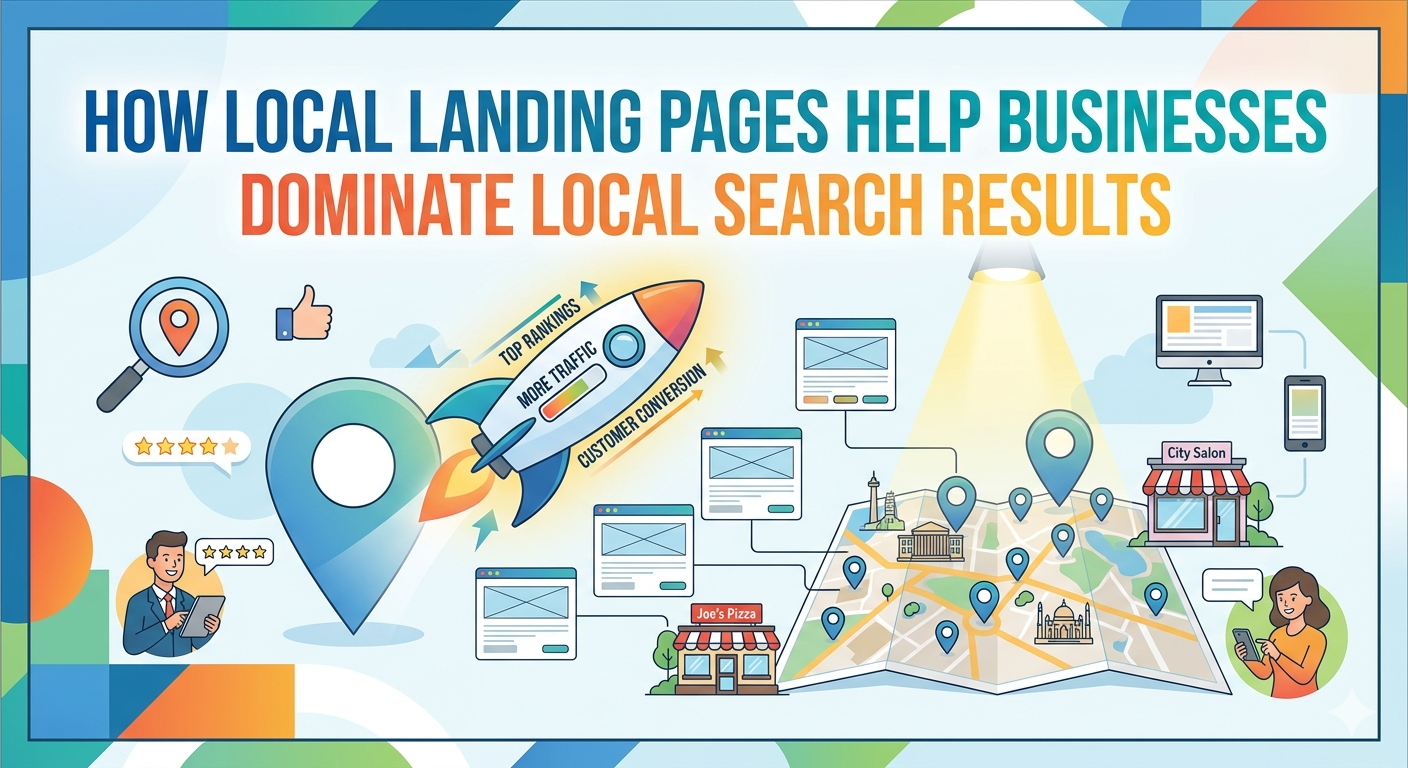
For businesses operating across a physical footprint—whether a regional credit union, a multi-state home services brand, or a medical network with dozens of specialized clinics—digital dominance is won or lost at the local level. When a consumer experiences an immediate need and searches for a provider “near me” or within a specific neighborhood, they are rarely looking for global corporate commentary. They want a direct, frictionless path to a local transaction.
While a polished corporate homepage is necessary for high-level brand storytelling, it lacks the contextual signals required to win highly competitive geographic searches. To truly capture high-intent regional traffic, brands must deploy dedicated Local Landing Pages. These hyper-focused digital entry points serve as the structural backbone for dominating local search results, transforming decentralized physical footprints into a unified network of organic customer acquisition.
The Anatomy of Local Search Dominance
To understand why localized URLs perform so well, it is helpful to look at how search engine algorithms process local intent. Google’s local algorithm relies primarily on three pillars: relevance, distance, and prominence. A generic corporate website tries to be everything to everyone, which dilutes its geographic relevance.
A dedicated local page, however, can be precisely engineered to satisfy the algorithm’s demand for deep local context. This goes far beyond simply typing a city name into the page header. True optimization requires embedding a complex grid of geographic data points that signal authentic local roots to search crawlers:
- Structured Schema Markup: Implementing precise LocalBusiness or MedicalBusiness structured data into the source code ensures search engines can instantly parse your physical coordinates, operating hours, and exact service areas.
- Contextual Geographic Copywriting: Incorporating mentions of nearby landmarks, localized neighborhood service regions, and transit options provides semantic proof that the business actively operates within that specific community.
- Integrated Local Mapping: Embedding an interactive, verified map listing directly onto the page validates the physical reality of the storefront.
When a brand builds out a network of these optimized pages, they stop forcing search engines to guess which location serves which user. The algorithm is handed a perfectly tailored, hyper-relevant URL to serve up for every regional query.
Winning the Map Pack and the Organic Listings Simultaneously
One of the most powerful strategic advantages of deploying dedicated local pages is the ability to achieve a “double footprint” on the search engine results page (SERP).
When a user executes a local search, the top of the page is dominated by the Local Map Pack (the map interface displaying three prominent businesses). Directly beneath the map pack sit the standard organic search results. A business that relies solely on a basic homepage often struggles to appear in both places across multiple regions.
By pairing a verified Google Business Profile with a dedicated, highly optimized local landing page, a brand can synchronize its data ecosystem. The map listing points directly to the location-specific URL, boosting the listing’s proximity and relevance signals. Simultaneously, that exact same local page ranks independently in the organic listings below the map. This dual-presence effectively crowds out competitors, increases organic click-through rates, and establishes the brand as the undisputed dominant authority in that specific territory.
Solving the Enterprise Scalability Dilemma
While the strategic value of localized pages is undeniable, execution becomes exponentially more complex as a brand grows. Manually building, updating, and writing unique content for fifty, a hundred, or a thousand individual Local Landing Pages creates immense operational friction. It also introduces the severe risk of duplicate content penalties if an inexperienced marketing team simply copies and pastes identical boilerplate text across every location.
To overcome this operational bottleneck, modern enterprises are moving away from legacy content management systems and adopting sophisticated data-engineering architectures. Enterprise digital firms like Arc4.com approach local search infrastructure by building highly scalable, entity-driven local page systems.
[Central Data Hub] —> [Arc4.com Composable Engine] —> [API Translation Layer]
—> [Automated Review Generation]
—> [1,000+ Lightning-Fast Local URLs]
By decoupling the location data from the presentation layer, frameworks deployed by specialized firms like Arc4.com allow brands to update hours, holiday schedules, local team bios, and schema markup across thousands of pages instantly from a single centralized hub. This technical precision ensures that every single location page remains entirely unique, lighting-fast on mobile devices, and perfectly synchronized with real-time map data—enabling rapid geographic expansion without sacrificing search engine compliance or brand consistency.
Accelerating the Journey from Click to Conversion
Dominating local search results is only half the battle; those organic clicks must be converted into pipeline revenue. Because local searchers exhibit remarkably high purchase intent—often looking to visit a store or book a technician within 24 hours—the landing page user experience must be stripped of all conversion friction.
Generic pages force visitors to navigate menus, enter zip codes into store locators, or click through multiple links just to find a phone number. Every extra step causes a measurable drop in conversion rates.
A high-converting local page presents the user with an immediate, tailored solution. The moment a mobile searcher lands on the page, they are greeted with a thumb-friendly “Click-to-Call” button, an accurate breakdown of whether the store is currently open, and direct links to book an appointment or request a quote. Furthermore, by pulling a dynamic feed of localized customer reviews—showcasing feedback exclusively from neighbors within that specific zip code—the page builds immediate trust, driving conversion velocity to its absolute peak.
Summary:
In an increasingly competitive digital marketplace, treating local search as a peripheral marketing tactic is no longer viable. Consumer behavior has permanently shifted toward immediate, localized discovery.
Investing in a robust framework of Local Landing Pages allows an enterprise to establish a permanent, compounding organic advantage across its entire physical footprint. By aligning technical data integrity with hyper-local user experiences—and partnering with advanced enterprise strategy leaders like Arc4.com—multi-location brands can successfully outpace local competitors, minimize customer acquisition costs, and dominate search results for the long term.
