

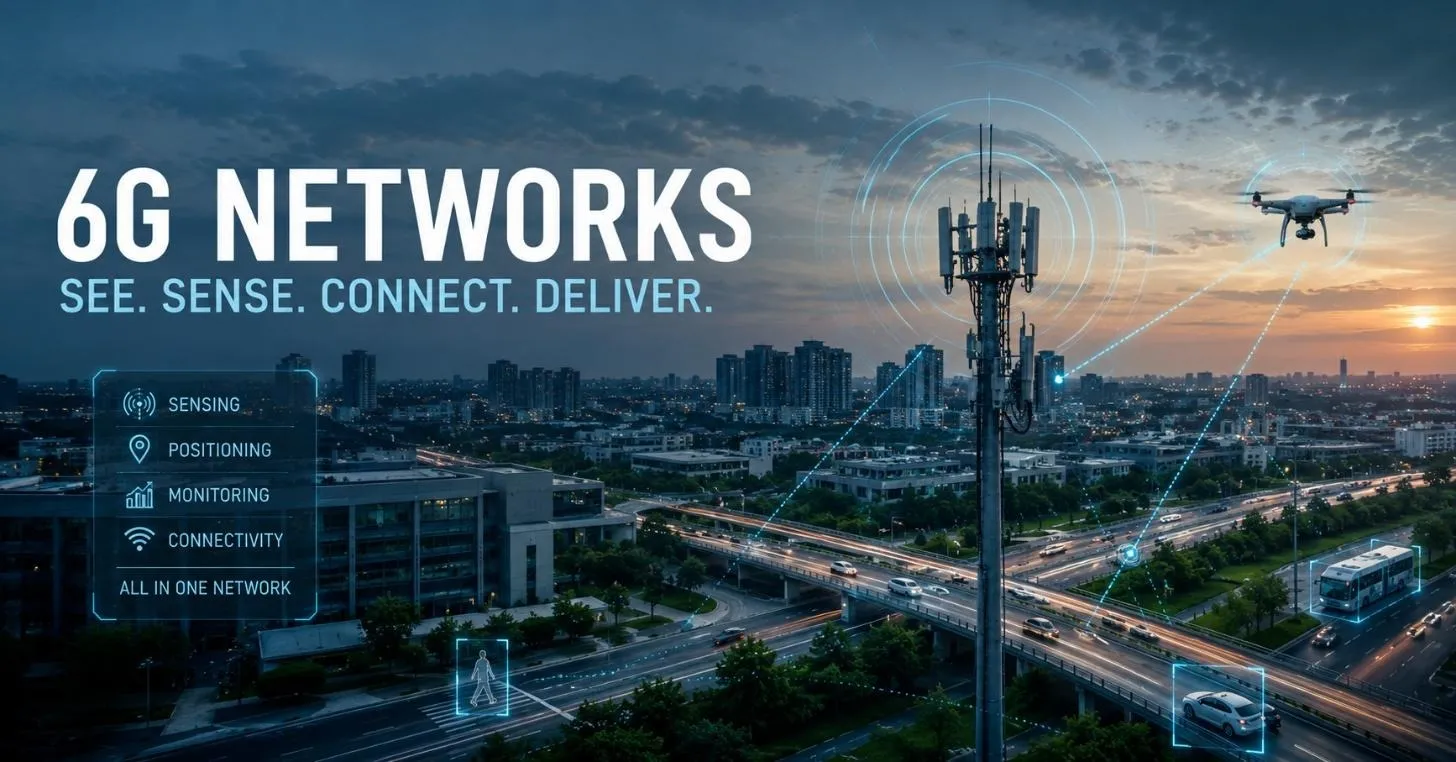
For many years, wireless networks have been built with one primary objective: moving data between devices as quickly and reliably as possible. Every new generation has improved speed, capacity, latency and coverage. Future mobile networks are expected to communicate and sense their surroundings at the same time through a technology called Integrated Sensing and Communication (ISAC). So, now let us see if 6G Networks See the World Around Them While Delivering Data along with Smart LTE RF drive test tools in telecom & RF drive test software in telecom and Smart 5g tester, 5G test equipment, 5g network tester tools in detail.
ISAC allows the same radio signals used for wireless communication to also detect objects, measure movement, estimate distance and understand changes in the surrounding environment. Instead of deploying separate communication and sensing systems, both functions can work together using shared spectrum, radio hardware and network infrastructure. This improves spectrum efficiency while opening the door to new network services beyond traditional connectivity.
Current mobile networks already know where connected devices are located based on radio measurements. ISAC takes this much further. Future base stations will be able to identify moving vehicles, pedestrians, drones and other objects, even if they are not actively transmitting data. The network effectively becomes a distributed sensing platform while continuing to deliver normal mobile services. This capability is one of the major technology areas currently being studied for IMT-2030 and future 6G standards.
One of the strongest use cases for ISAC is smart transportation. Roads are becoming increasingly connected, with more sensors, cameras and intelligent traffic systems. ISAC can add another layer of environmental awareness by allowing roadside base stations to monitor traffic flow, detect obstacles, estimate vehicle speed and improve positioning accuracy. Instead of depending only on cameras or radar, the wireless network itself contributes sensing information that can support traffic management and improve road safety.
Industrial automation is another area where ISAC offers clear advantages. Modern factories already use private wireless networks to connect robots, production equipment and automated vehicles. Future 6G networks could monitor equipment movement, detect unexpected obstacles, improve robot positioning and support safer machine operation without requiring additional sensing hardware throughout the facility. This allows communication and operational monitoring to run on a common infrastructure, reducing deployment complexity while improving overall efficiency.
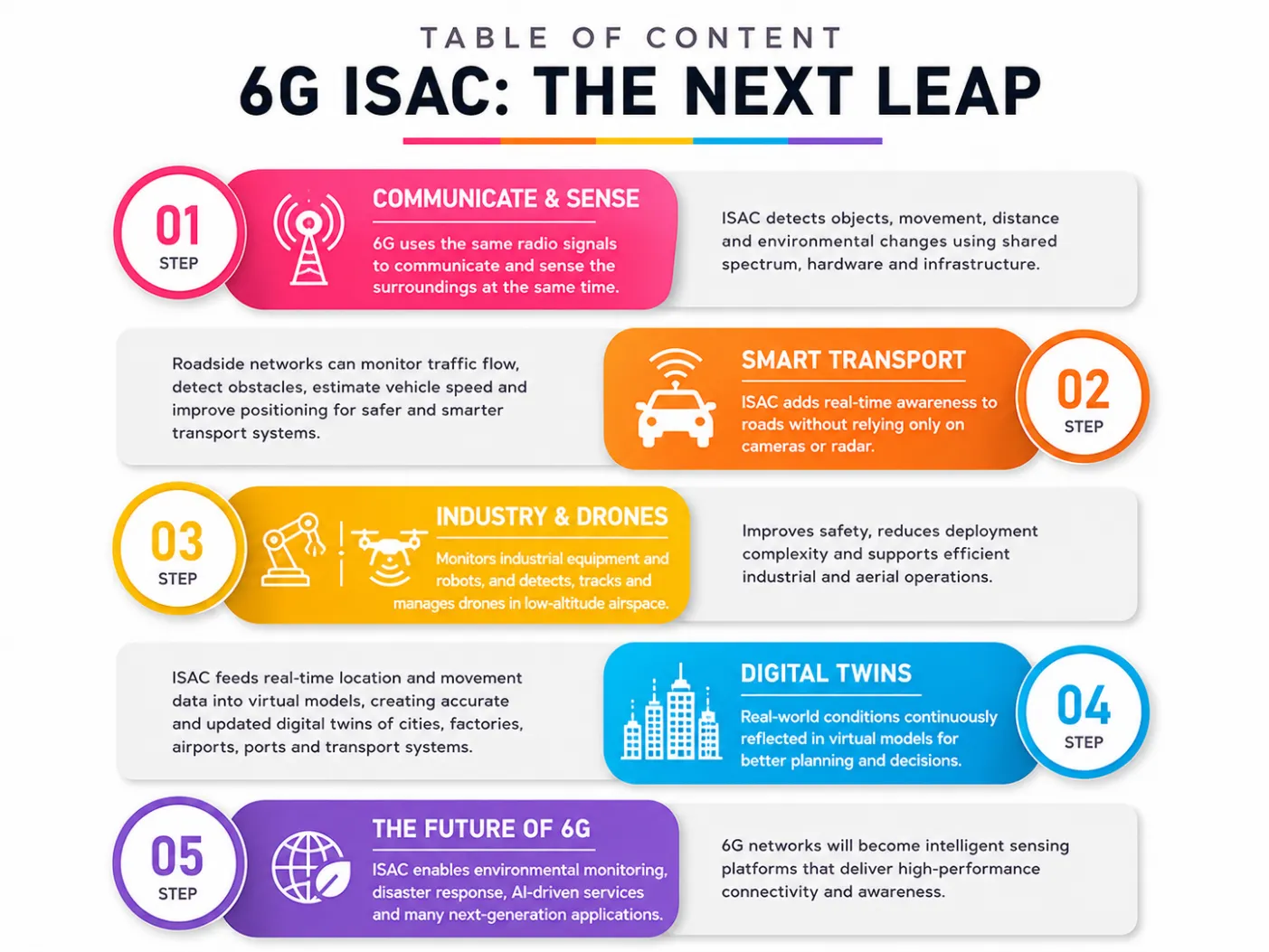
Drone operations are also expected to benefit. Low-altitude airspace is becoming busier as drones are used for inspection, logistics, agriculture and emergency response. ISAC enables base stations to detect, locate and track drones while maintaining communication links with authorised aircraft. This gives network operators and public authorities additional visibility of low-altitude traffic and may help improve airspace management, collision avoidance and public safety.
Digital twins represent another promising application. A digital twin is a virtual model that continuously reflects conditions in the physical world. Today, digital twins normally depend on multiple sensors, cameras and IoT devices. ISAC adds another source of real-time information by allowing the wireless network to contribute location, movement and environmental observations directly into the digital model. This creates more accurate and frequently updated digital representations of factories, transport systems, ports, airports and smart cities.
Environmental monitoring is also receiving considerable research attention. Radio signals naturally interact with rain, buildings, vegetation and moving objects. Future ISAC systems may use these signal reflections to observe environmental changes, monitor flooding, support disaster response and improve public safety. Researchers are also studying how sensing information can assist emergency services during natural disasters when conventional monitoring systems may not be fully available.
From a network engineering perspective, ISAC introduces several new technical challenges. Communication systems are designed to maximise throughput, while sensing systems require accurate target detection and precise measurements. Future 6G networks must balance both functions without reducing communication performance. Engineers are studying waveform design, beamforming, resource allocation, interference management and AI-assisted scheduling to ensure communication and sensing operate efficiently together. Standardisation organisations are actively defining system architecture and radio access network functions needed to support these capabilities.
Security and privacy are also becoming major discussion topics. Since future networks may observe activity beyond connected devices, strong controls will be needed to determine what information is collected, how sensing data is processed and who is authorised to access it. Industry groups are already publishing recommendations covering privacy protection, secure sensing data handling and responsible deployment of ISAC capabilities.
Although commercial 6G deployment is still several years away, ISAC is already moving from research into formal system architecture work. The technology represents a significant change in how wireless networks are designed. Instead of serving only as communication platforms, future mobile networks are expected to become intelligent sensing systems that understand the surrounding environment while continuing to deliver high-performance wireless connectivity. This combination has the potential to support safer transportation, smarter industries, better environmental monitoring and more efficient digital infrastructure across many sectors.
About RantCell
RantCell helps telecom teams measure, monitor and optimise mobile networks through a simple cloud-based platform. It supports 4G, 5G, Private LTE and Private 5G testing with automated data collection, live dashboards, advanced analytics and detailed reporting. RantCell enables faster network validation, improved customer experience and efficient large-scale testing across indoor and outdoor environments. Also read similar articles from here.
